Western Australia has had 20 new cases of leprosy in the past five years. The disease disproportionately affects Aboriginal and Torres Strait Islander communities.
So what is leprosy? And why isn’t it a thing of the past?
Showing posts with label 19th century. Show all posts
Showing posts with label 19th century. Show all posts
Thursday, September 20, 2018

Wednesday, August 19, 2015
Finding Gonorrhoea
Long term followers of this blog will know that here at medical history we enjoy a good story about a sexually transmitted infection.
Normally it's syphilis but today I thought we'd make a side track into gonorrhoea.
Saturday, November 29, 2014
Asthma cigarettes
Some of you may have seen this particular image doing the rounds a while back. I'm guilty of posting it myself without comment to my facebook page because, you know, smoking and asthma! Funny!

As with every meme that does the rounds on facebook, however, the wider historical context of this one probably got a little bit missed in the details.
So let's have a little bit of a chat about 'Asthma cigarettes'.

So let's have a little bit of a chat about 'Asthma cigarettes'.
Thursday, October 2, 2014
Rear endings
An enema, where fluid is inserted into the bowel via the rectum, is a very useful tool in a doctor or a nurse's toolkit.
It's also often the butt of many, many a joke. (Forgive me for that one. I couldn't help myself).
In modern medicine enemas are most frequently used to help with constipation, clear the bowel out prior to a surgical procedure such as a colonoscopy or to help in imaging, for example in a barium enema.
However it may surprise you to know that history of human's sticking fluid up their rectums is a long and, well, somewhat obsessed one.
It's also often the butt of many, many a joke. (Forgive me for that one. I couldn't help myself).
In modern medicine enemas are most frequently used to help with constipation, clear the bowel out prior to a surgical procedure such as a colonoscopy or to help in imaging, for example in a barium enema.
However it may surprise you to know that history of human's sticking fluid up their rectums is a long and, well, somewhat obsessed one.
Saturday, July 26, 2014
An Eye for War.
This wasn't the post I was planning to write, I had one planned about leprosy, - but I can never resist a story about a good Australian doctor, so hopefully you can all wait a little longer for that tale.
Today we are going to talk about the wonderfully named Sir Charles Snodgrass Ryan who was born on Killeen Station in Victoria on the 20th September 1853. He studied at the University of Melbourne and then completed his study at the University of Edinburgh (Australian medical degrees were not wholly awarded in Australia until well into the 20th century - in fact up until very recently, most Australian doctors would complete at least some of their training in the United Kingdom). He then undertook further postgraduate training as a surgeon in Italy and Austria.

Today we are going to talk about the wonderfully named Sir Charles Snodgrass Ryan who was born on Killeen Station in Victoria on the 20th September 1853. He studied at the University of Melbourne and then completed his study at the University of Edinburgh (Australian medical degrees were not wholly awarded in Australia until well into the 20th century - in fact up until very recently, most Australian doctors would complete at least some of their training in the United Kingdom). He then undertook further postgraduate training as a surgeon in Italy and Austria.

Sir Ryan at the time of his enlistment (public domain image sourced from the Australian War Memorial Collection)
Wednesday, June 4, 2014
Round the Bend
This last week juggling work and a little baby I have found myself frequently thinking that I am going round the bend.
Which of course then leads me to wondering where that phrase may have originated. As your author tends to do.
Clearly the expression has something to do with mental health. There is a school of thought that suggests it may have to do with the fact that many mental asylums were at the end of windy roads.
However I once heard a much more interesting theory, which also happens to be local, that I'd like to share with you today.
Which of course then leads me to wondering where that phrase may have originated. As your author tends to do.
Clearly the expression has something to do with mental health. There is a school of thought that suggests it may have to do with the fact that many mental asylums were at the end of windy roads.
However I once heard a much more interesting theory, which also happens to be local, that I'd like to share with you today.
Sunday, March 23, 2014
Whiskey business
Around about 1850 a boy named Jasper Newton Daniel was born in Tennessee . One of 12 children, he was quickly nicknamed Jack. At the age of 10, Jack was apprenticed to the local storekeeper who also happened to be the local Lutheran minister, Reverend Call.
Like many good men of the cloth, Rev. Call enjoyed a drink. As a storekeeper he could run his own still. Whiskey was his drink and using traditional Lincoln county processes made Rev. Call's whiskey well sought after. Jack took to the trade like a duck to water. (Or a drinker to his whiskey...)

Like many good men of the cloth, Rev. Call enjoyed a drink. As a storekeeper he could run his own still. Whiskey was his drink and using traditional Lincoln county processes made Rev. Call's whiskey well sought after. Jack took to the trade like a duck to water. (Or a drinker to his whiskey...)
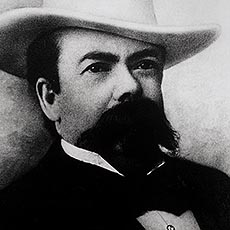
(public domain image sourced from wikipedia)
Friday, September 6, 2013
Ladies Man
In 1809 a young man named James Barry began his medical studies at the University of Edinburgh. He graduated in 1812 and went on to train at the combined hospitals of St Thomas and Guy's, going on to pass his exams and recieve admittance to the Royal College of Surgeons. Following this he joined the Army, qualifying as a regimental assistant.
Barry was described as irascible and prickly. Standing only five foot tall, with a high pitched voice, he responded angrily to the frequent taunting that was a part of Army life. In fact he fought at least two duels over insults - shooting an opponent in one and being injured in the other. He was also quite eccentric, travelling with his Jamaican manservant, John, his dog and a goat for milk. He also was always dressed in full regimentals, including cavalry sword and was noted for wearing 3 inch lifts in his shoes.

Barry was described as irascible and prickly. Standing only five foot tall, with a high pitched voice, he responded angrily to the frequent taunting that was a part of Army life. In fact he fought at least two duels over insults - shooting an opponent in one and being injured in the other. He was also quite eccentric, travelling with his Jamaican manservant, John, his dog and a goat for milk. He also was always dressed in full regimentals, including cavalry sword and was noted for wearing 3 inch lifts in his shoes.
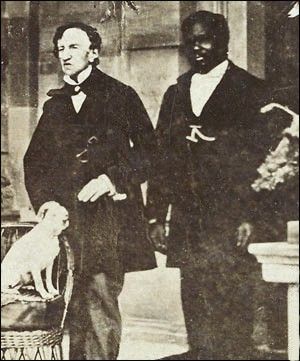
John Barry, his servant John and his dog, circa 1850
(public domain image sourced from Wikipedia)
Saturday, October 20, 2012
Alice Bunker Stockham and Tokology
One of the nurses at work, knowing my love for all things medical and historical decided to loan me a book.

Tokology: A book for every woman was authored by Alice Bunker Stockham (1833-1912) in 1886 (although I believe this copy is almost certainly a later edition. It is essentially a guide for the layman about pregnancy and women's health. Stockham is an utterly intriguing character. An obstetrician and gynaecologist from Chicago, she was only the fifth woman to be made a doctor in the United States.

Tokology: A book for every woman was authored by Alice Bunker Stockham (1833-1912) in 1886 (although I believe this copy is almost certainly a later edition. It is essentially a guide for the layman about pregnancy and women's health. Stockham is an utterly intriguing character. An obstetrician and gynaecologist from Chicago, she was only the fifth woman to be made a doctor in the United States.
Subscribe to:
Posts (Atom)