Pages

Showing posts with label 18th century. Show all posts

Monday, June 8, 2015

Digitalis - or putting my toddler into heartblock

My family and I have recently moved to a different part of the country and while I wait for the paperwork to go through to start a new job I am getting on with planting a garden in our new home.  I came home with seeds - pansies, sunflowers, violets and foxglove all of which looked very pretty on the packet and was planting them while my toddler enthusiastically "helped" (as toddlers do).

It wasn't until I was about ready to plant and looking at the packet for a second time that a bell started ringing in my head.  I turned it over and sure enough, there in very small print was the warning that foxglove was poisonous if ingested.  With the small tornado enthusiastically eating grass beside me, the seeds were quickly disposed of in the bin.

So what is foxglove, apart from quite pretty?

(public domain image sourced from wikipedia)

Sunday, November 2, 2014

Dr. Richard Mead - Generous Georgian

I recently got invited to the opening of an exhibition at the Foundling museum.  Your correspondent was doubly excited a) because she has never been taken seriously as a blogger before and b) because it was about a really interesting character named Dr. Richard Mead. 

Also your correspondent really enjoys a good medical history exhibit. 

Unfortunately she ran up against the smallish problem whereby she lives in Australia with a toddler and an obstetric practice and the exhibition is in London. 

The people at the Foundling museum have been kind enough to bring the exhibition to me, and today I am going to bring a little of it to you.  If you are in London, though, please go, tell me how awesome it is and turn me green with jealousy!

Thursday, October 2, 2014

Rear endings

An enema, where fluid is inserted into the bowel via the rectum, is a very useful tool in a doctor or a nurse's toolkit.

It's also often the butt of many, many a joke.  (Forgive me for that one.  I couldn't help myself).


In modern medicine enemas are most frequently used to help with constipation, clear the bowel out prior to a surgical procedure such as a colonoscopy or to help in imaging, for example in a barium enema. 


However it may surprise you to know that history of human's sticking fluid up their rectums is a long and, well, somewhat obsessed one.


Sunday, July 15, 2012

Wascally Wabbits


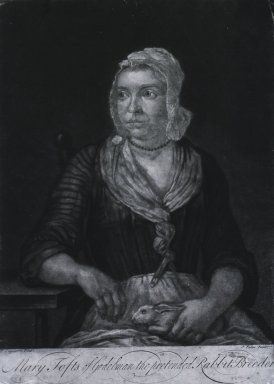
In September 1726 a young woman named Mary Toft, about 25 at the time, went into labour with her third child.  The pregnancy had been complicated.  Forced to undertake heavy work in the fields throughout she stated that she had suffered a great deal of pain and a month prior had passed several pieces of flesh and clots.

On the night Mary laboured in September her neigbour watched incredulously as Mary produced several pieces of animal flesh.  The neighbour showed these to Mary's mother in law, a midwife, who contacted John Howard a local surgeon and "man-midwife".

Sceptical, Howard attended Mary the following day.  Initially he found nothing. However Mary once again went into labour a few days later.  Howard returned and subsequently delivered three legs of a tabby cat, a rabbit leg and the intestines of a cat.