I recently got invited to the opening of an exhibition at the Foundling museum. Your correspondent was doubly excited a) because she has never been taken seriously as a blogger before and b) because it was about a really interesting character named Dr. Richard Mead.
Also your correspondent really enjoys a good medical history exhibit.
Unfortunately she ran up against the smallish problem whereby she lives in Australia with a toddler and an obstetric practice and the exhibition is in London.
The people at the Foundling museum have been kind enough to bring the exhibition to me, and today I am going to bring a little of it to you. If you are in London, though, please go, tell me how awesome it is and turn me green with jealousy!
Showing posts with label British Monarchy. Show all posts
Showing posts with label British Monarchy. Show all posts
Sunday, November 2, 2014

Saturday, May 17, 2014
How a spirochete secured the English succession
The year was 1565 and Mary, Queen of Scots was on the hunt for a husband.

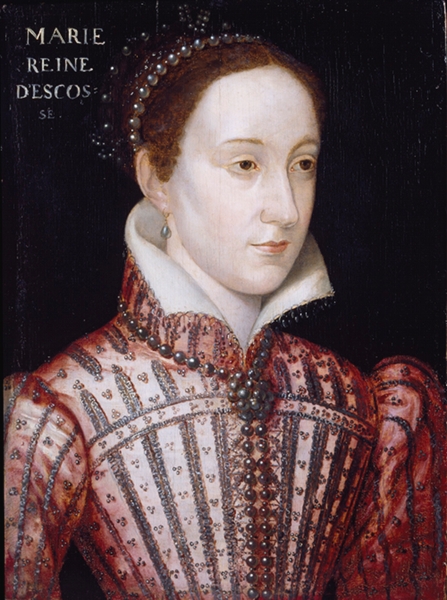
(Mary - Public domain image sourced from Wikipedia)
Wednesday, October 9, 2013
Black hearted
In December 1535 Catherine of Aragon wrote to her husband Henry VIII and included her last will and testament.

Although she recognised herself as the his first wife, Henry himself did not do so, styling her only as the Dowager Duchess of York, a title she held when married to his older brother Arthur. Their marriage had been declared invalid based on the idea that a man should not marry his brother's wife, some three years prior. This had paved the way for Henry to marry his long term mistress, Anne Boelyn. It had also disinherited Catherine's daughter, Mary, a fact which caused her great distress and one she refused to recognise.

(Public domain image sourced from wikipedia).
Although she recognised herself as the his first wife, Henry himself did not do so, styling her only as the Dowager Duchess of York, a title she held when married to his older brother Arthur. Their marriage had been declared invalid based on the idea that a man should not marry his brother's wife, some three years prior. This had paved the way for Henry to marry his long term mistress, Anne Boelyn. It had also disinherited Catherine's daughter, Mary, a fact which caused her great distress and one she refused to recognise.
Sunday, November 11, 2012
Obstetrics and WWI
As we come to the end of Remembrance Day for another year, I found myself reflecting on a medical history story that directly relates to the onset of WWI.
The brachial plexus is a group of nerves which supplies the arm and hand. They run from the spinal cord and through the neck into the arm. As a result they are unfortunately susceptible to trauma during the birth process. Particularly this can occur during an obstetric emergency where a baby's head becomes trapped during birth, either from the shoulders being wedged under the mother's pubic bone or an obstructed breech (feet first) birth. The subsequent mechanical manipulation required to free the baby is the usual cause. However when certain death is the alternative - sometimes a brachial plexus palsy is the lesser of two traumas.
Unfortunately, Kaiser Wilhelm did not see it this way.

The brachial plexus is a group of nerves which supplies the arm and hand. They run from the spinal cord and through the neck into the arm. As a result they are unfortunately susceptible to trauma during the birth process. Particularly this can occur during an obstetric emergency where a baby's head becomes trapped during birth, either from the shoulders being wedged under the mother's pubic bone or an obstructed breech (feet first) birth. The subsequent mechanical manipulation required to free the baby is the usual cause. However when certain death is the alternative - sometimes a brachial plexus palsy is the lesser of two traumas.
Unfortunately, Kaiser Wilhelm did not see it this way.

Sunday, August 12, 2012
George V: Mercy or Convenience?
George V grandfather of the current British monarch, Elizabeth II was born in 1865 and died on the 20th January 1936. He reigned from the 6th May 1910 until his death. He is notable for being the reigning monarch during the first world war.


(George V)
Sunday, July 15, 2012
Wascally Wabbits
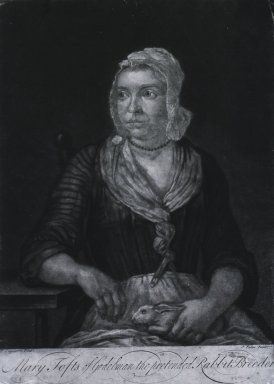
In September 1726 a young woman named Mary Toft, about 25 at the time, went into labour with her third child. The pregnancy had been complicated. Forced to undertake heavy work in the fields throughout she stated that she had suffered a great deal of pain and a month prior had passed several pieces of flesh and clots.
On the night Mary laboured in September her neigbour watched incredulously as Mary produced several pieces of animal flesh. The neighbour showed these to Mary's mother in law, a midwife, who contacted John Howard a local surgeon and "man-midwife".
Sceptical, Howard attended Mary the following day. Initially he found nothing. However Mary once again went into labour a few days later. Howard returned and subsequently delivered three legs of a tabby cat, a rabbit leg and the intestines of a cat.
Thursday, July 5, 2012
The D-Downfall of Anne Boelyn
Anne Boelyn.
Love her or hate her, it's hard to decide.
Henry the Eighth couldn't really figure it out either.

Anne Boelyn was born somewhere between 1501 and 1507 at Hever Castle in Kent. She was sent to France to wait apon Queen Claude of France and complete her studies, returning to England when she was about twenty. This education in France proved pivotal and may have shaped some of Anne's more reformative beliefs in her later life.
Anne's family, and in particular her Uncle, Thomas Howard, the Duke of Norfolk, were ambitious for position at court. They must have been delighted when Anne quickly caught the eye of King Henry VIII in 1526 and that within a year he had proposed marriaged to her.
The slight problem being, of course, that he was already married to Catherine of Aragon.
Catherine of Aragon, Henry's first wife, had birthed six children. A stillborn son, a stillborn daughter, two sons who lived less than a month, both named Henry, Duke of Cornwell, an unnamed daughter who lived less than a week, and Mary, who would go on to become Queen of England.
She had not borne a living son, and Henry was determined to set her aside.
Love her or hate her, it's hard to decide.
Henry the Eighth couldn't really figure it out either.
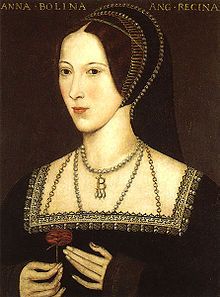
Anne Boelyn was born somewhere between 1501 and 1507 at Hever Castle in Kent. She was sent to France to wait apon Queen Claude of France and complete her studies, returning to England when she was about twenty. This education in France proved pivotal and may have shaped some of Anne's more reformative beliefs in her later life.
Anne's family, and in particular her Uncle, Thomas Howard, the Duke of Norfolk, were ambitious for position at court. They must have been delighted when Anne quickly caught the eye of King Henry VIII in 1526 and that within a year he had proposed marriaged to her.
The slight problem being, of course, that he was already married to Catherine of Aragon.
Catherine of Aragon, Henry's first wife, had birthed six children. A stillborn son, a stillborn daughter, two sons who lived less than a month, both named Henry, Duke of Cornwell, an unnamed daughter who lived less than a week, and Mary, who would go on to become Queen of England.
She had not borne a living son, and Henry was determined to set her aside.
Friday, November 25, 2011
Queen Victoria Feels no Pain
Women giving birth in the modern era owe a great deal of gratitude to Queen Victoria, although these facts are not widely known. However, were it not for her, it is possible that stigmas surrounding pain relief in childbirth might still exist.
But before we explore this, we must first discuss some of the early history of anaesthetics.
It’s hard to imagine a world without anaesthetics. We use them liberally in almost every facet of medicine, from the simple insertion of cannulas, to keeping people unconscious on the operating table for hours at a time.
So it may surprise you to learn that while the history of surgery is almost as old as medicine, the concept of anaesthetics has only been around since the nineteenth century.
But before we explore this, we must first discuss some of the early history of anaesthetics.
It’s hard to imagine a world without anaesthetics. We use them liberally in almost every facet of medicine, from the simple insertion of cannulas, to keeping people unconscious on the operating table for hours at a time.
So it may surprise you to learn that while the history of surgery is almost as old as medicine, the concept of anaesthetics has only been around since the nineteenth century.
Monday, October 3, 2011
Bad Blood
In 1817 the death of Princess Charlotte Augusta of Wales, George IV’s only legitimate child and George III’s only grandchild-heir sent the British monarchy into a spin. George IV’s three younger brothers suddenly realised that they would be tasked with the responsibility of preserving the lineage.
While George IV had twelve other healthy children all were illegitimate.
Alexadrina Victoria was born on the 24th May 1819, the first and only child of Prince Edward, Duke of Kent and Princess Victoria of Saxe-Coburg-Saalfeld. At the time of her birth she was fifth in line to the throne after her three uncles and father. Her father, aged 51 at the time of her birth, died a little over six months later. (3)
It’s possible that that his late-life decision to reproduce resulted in a genetic heritage that continues to haunt the royal houses of Europe today.
While George IV had twelve other healthy children all were illegitimate.
Alexadrina Victoria was born on the 24th May 1819, the first and only child of Prince Edward, Duke of Kent and Princess Victoria of Saxe-Coburg-Saalfeld. At the time of her birth she was fifth in line to the throne after her three uncles and father. Her father, aged 51 at the time of her birth, died a little over six months later. (3)
It’s possible that that his late-life decision to reproduce resulted in a genetic heritage that continues to haunt the royal houses of Europe today.
Saturday, November 6, 2010
Henry the Eighth I am I am
I have recently spent a great deal of my time thinking about the health of Henry VIII.
This may be, in part, because I have spent a great deal of my time recently watching The Tudors from start to finish. Not to mention a long term fascination with the history of the English Royalty which is, in many myriad ways, far more entertaining than any soap opera.
I had always supposed that Henry VIII died from syphilis. This has certainly been the theory that both of my colleagues and my mother repeated to me when I mentioned that I was watching the Tudors. However as I watched the show in question dramatically detail Henry’s ailments I remembered that Jonathan Rhys Meyers is a physically rather sympathetic portrait of the good King. With the constellation of symptoms as described another diagnosis, to my mind, became much more clinically apt.
I was very gratified in the course of my research to discover that many other scholars had also come to a similar conclusion.
Let us first consider Henry.

This may be, in part, because I have spent a great deal of my time recently watching The Tudors from start to finish. Not to mention a long term fascination with the history of the English Royalty which is, in many myriad ways, far more entertaining than any soap opera.
I had always supposed that Henry VIII died from syphilis. This has certainly been the theory that both of my colleagues and my mother repeated to me when I mentioned that I was watching the Tudors. However as I watched the show in question dramatically detail Henry’s ailments I remembered that Jonathan Rhys Meyers is a physically rather sympathetic portrait of the good King. With the constellation of symptoms as described another diagnosis, to my mind, became much more clinically apt.
I was very gratified in the course of my research to discover that many other scholars had also come to a similar conclusion.
Let us first consider Henry.
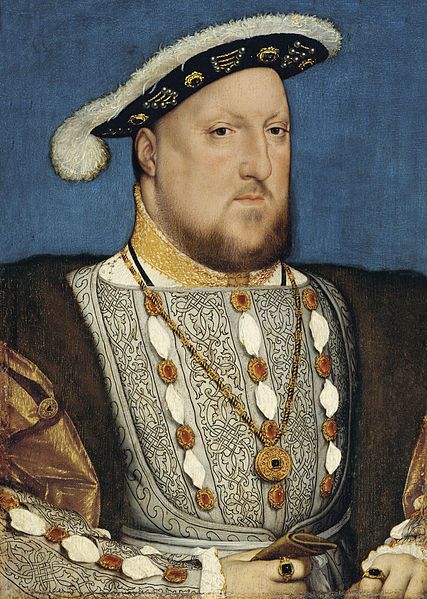
(Public domain image sourced from wikipedia)

Subscribe to:
Posts (Atom)