Pages

Sunday, March 23, 2014

Whiskey business

Around about 1850 a boy named Jasper Newton Daniel was born in Tennessee . One of 12 children, he was quickly nicknamed Jack.  At the age of 10, Jack was apprenticed to the local storekeeper who also happened to be the local Lutheran minister, Reverend Call.

Like many good men of the cloth, Rev. Call enjoyed a drink. As a storekeeper he could run his own still. Whiskey was his drink and using traditional Lincoln county processes made Rev. Call's whiskey well sought after.  Jack took to the trade like a duck to water.  (Or a drinker to his whiskey...)

 (public domain image sourced from wikipedia)

Tuesday, February 18, 2014

Mother and Child: Vera Scantlebury Brown

Dear Readers: I must apologise for my long absence.  I have been very busy having recently produced a Baby Turkey and then attempting not to kill said Baby Turkey.  Fortunately it's more difficult than it seems.

Thankfully in the ongoing endevour to keep my offspring alive I have been assisted by many individuals some of whom are the marvellous freely available maternal and child health nurses here in Australia.  In honour of them I thought today we might talk about an Australian doctor who was instrumental in helping to set up that public health service many years ago, Vera Scantlebury-Brown.

Vera Scantlebury was born in 1889 in rural Victoria. Her father was a country doctor, and he and her mother raised all their children to believe in the importance of educational attainment, regardless of sex.


Wednesday, October 9, 2013

Black hearted

In December 1535 Catherine of Aragon wrote to her husband Henry VIII and included her last will and testament.

 (Public domain image sourced from wikipedia).

Although she recognised herself as the his first wife, Henry himself did not do so, styling her only as the Dowager Duchess of York, a title she held when married to his older brother Arthur.  Their marriage had been declared invalid based on the idea that a man should not marry his brother's wife, some three years prior.  This had paved the way for Henry to marry his long term mistress, Anne Boelyn.  It had also disinherited Catherine's daughter, Mary, a fact which caused her great distress and one she refused to recognise. 

Friday, September 6, 2013

Ladies Man

In 1809 a young man named James Barry began his medical studies at the University of Edinburgh.  He graduated in 1812 and went on to train at the combined hospitals of St Thomas and Guy's, going on to pass his exams and recieve admittance to the Royal College of Surgeons.  Following this he joined the Army, qualifying as a regimental assistant.

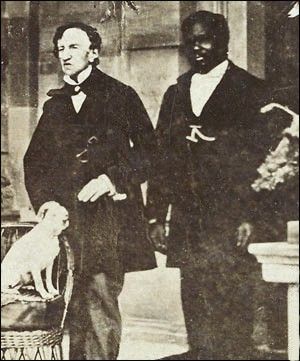
Barry was described as irascible and prickly.  Standing only five foot tall, with a high pitched voice, he responded angrily to the frequent taunting that was a part of Army life.  In fact he fought at least two duels over insults - shooting an opponent in one and being injured in the other.  He was also quite eccentric, travelling with his Jamaican manservant, John, his dog and a goat for milk.  He also was always dressed in full regimentals, including cavalry sword and was noted for wearing 3 inch lifts in his shoes. 


John Barry, his servant John and his dog, circa 1850
(public domain image sourced from Wikipedia)
Tuesday, June 11, 2013

Another wife easily found: Jane Seymour

Today we continue this blog's obsession with the Tudor period with a discussion about King Henry VIII's third wife, Jane Seymour.

In January 1536 Henry's second wife, Anne Boelyn, miscarried a son at four months gestation.  This followed two other miscarriages of male infants after the birth of a healthy daughter, Elizabeth.  This proved to be the final straw for Henry, who placed Anne on trial for witchcraft and had her beheaded soon after on the 19th May 1536.

In between the miscarriage and the beheading, Henry moved his mistress, Jane Seymour, into the palace.  The two were formally engaged on the 20th May, 1536, the day after Anne's execution, and married ten days later on the 30th May at Whitehall.  However Jane was never crowned as Queen as court remained away from London to avoid an outbreak of plague.